The most realistic AI voices in 2026: how natural does text to speech sound now?
How realistic is text to speech in 2026? What makes an AI voice sound human, what still gives it away, and how to choose the most realistic AI voice for you.
In 2026, the most realistic AI voices are very hard to tell apart from a human in short clips. Modern neural and LLM-based text to speech handles rhythm, emphasis and emotion in a way older robotic voices never could. They still slip up, mostly over long passages, with unusual names and numbers, and when the emotion doesn’t fit the context. Here’s what makes realistic text to speech sound human, what still gives it away, and how to pick a voice that works for you.
What makes a voice sound human?
When people say a voice sounds “robotic”, they rarely mean the sound of individual words. Older synthetic voices could pronounce words clearly. What they lacked was everything around the words.
Prosody: the music of speech
Prosody is the rise and fall of pitch, the stress on certain words and the rhythm of a sentence. It’s how we tell a question from a statement, and how “I didn’t say she took it” can mean several different things depending on which word is stressed. Realistic text to speech has to work out which words matter in a sentence and stress them, without being told.
Pacing and pauses
Humans don’t speak at a steady rate. We slow down for important points, speed up through familiar phrases and pause at commas, between ideas and before a punchline. Natural-sounding pauses are one of the biggest differences between a flat voice and a convincing one.
Breathing and small imperfections
Real speech has small breaths, slight changes in voice quality and the occasional softening at the end of a sentence. The best AI voices include some of these, which makes them easier to listen to for longer. Too many, though, and the voice starts to sound performed rather than natural.
Emotion and tone
A sentence about good news should sound different from a sentence about bad news. The most realistic AI voice is one whose tone matches what’s being said: warm, calm, excited or serious as the text demands.
Context
Humans read whole paragraphs, not isolated sentences. We know that “read” is pronounced differently in “I read it yesterday” and “I’ll read it later”, and that a list should sound like a list. Voices that understand context sound more natural over longer text.
How neural and LLM-based text to speech changed things
For decades, text to speech was built either by stitching together tiny recorded fragments of speech or by rule-based models. The results were understandable but mechanical.
The turning point came with neural networks. In September 2016, DeepMind published WaveNet, a model that generated speech one audio sample at a time. DeepMind reported that it reduced the gap between the best existing systems and human speech by over 50% in listening tests. Neural voices quickly became the standard across the industry.
The next shift has been models that borrow techniques from large language models. Rather than just converting words to sounds, they draw on a broader sense of what the text means, which helps with emphasis, emotion and natural rhythm. Some now take direction in plain language or simple tags:
- OpenAI’s gpt-4o-mini-tts accepts written instructions describing how text should be spoken, such as a tone or speaking style, according to OpenAI’s developer documentation.
- ElevenLabs’ Eleven v3 model introduced “audio tags”, words in square brackets such as [whispers], [sighs] or [laughs] that direct how a line is delivered, according to ElevenLabs.
The result is that realistic text to speech in 2026 can sound expressive in ways that were difficult to achieve only a few years ago. If you’d like to see how the main providers compare, our guide to text to speech providers compared covers cost, quality and latency.
Who makes the most realistic AI voice?
There’s no single, settled answer, and we’d be wary of anyone who claims one. Realism depends on the language, the voice, the text and the listener.
What we can say is that ElevenLabs is widely known for expressive, realistic voices, and that large providers such as Google, Microsoft and OpenAI all offer neural voices that sound far more natural than older systems. Independent, crowdsourced comparisons such as TTS Arena, launched on Hugging Face, ask listeners to pick between two anonymous voices reading the same text, which is a fairer test than any company’s own demo. Rankings on leaderboards like this move as new models are released, so treat any “number one” as a snapshot.
The practical takeaway: the most realistic AI voice is the one that sounds most natural to you, in your language and accent, saying the kinds of things you actually say.
What still gives AI voices away
Even the best AI voice generator has tells. Knowing them helps you choose and use voices well.
- Long passages. A voice can sound perfect for a sentence and then fall into a repetitive rhythm over several paragraphs, with every sentence ending the same way.
- Names, numbers and abbreviations. Unusual names, place names, dates, prices and acronyms are still common stumbling points. “Dr” might come out as “drive”, and “1/2” might be read wrongly.
- Mismatched emotion. A cheerful voice reading sad news, or excitement in the wrong place, breaks the illusion quickly.
- Over-perfect delivery. No hesitations, no variation in pace and perfectly even volume can sound slightly too polished.
- Odd emphasis. Stressing the wrong word in a sentence changes its meaning and is one of the quickest ways a listener notices something is off.
- Glitches. Occasional artefacts, clipped words or strange pronunciations still happen, especially with very short or very unusual text.
Many of these can be reduced with how you write. Our guide on how to make text to speech sound natural has practical tips, like writing numbers out and using punctuation to guide pauses.
Tips for choosing a realistic voice
- Listen to your own words. Demo sentences are chosen to sound good. Try the phrases you’ll actually use, including names and numbers.
- Match the accent and age. A voice that suits you, in your accent, sounds more natural to the people who know you than a “perfect” voice that doesn’t. Filters for language, gender and age make this much faster.
- Test short and long. If you’ll speak short phrases in conversation, test those. If you’ll listen to long documents, test a few paragraphs.
- Check speed. For conversation, a voice that starts speaking quickly matters as much as how it sounds.
- Think about offline. Cloud AI voices usually need a connection. On-device voices are less expressive but always available.
- Live with it for a day. A voice that impresses in ten seconds can grate after an hour. Give your favourite a proper try.
Hearing the difference for yourself
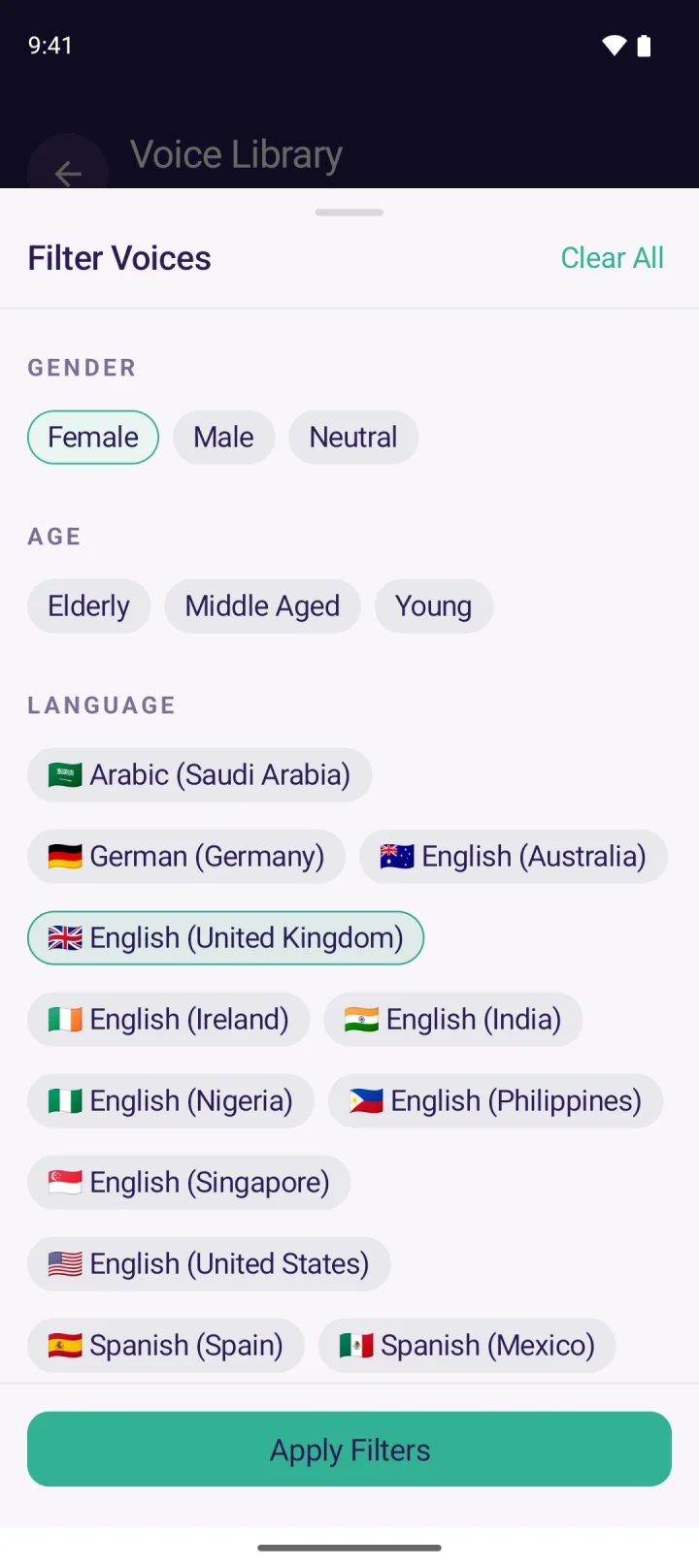
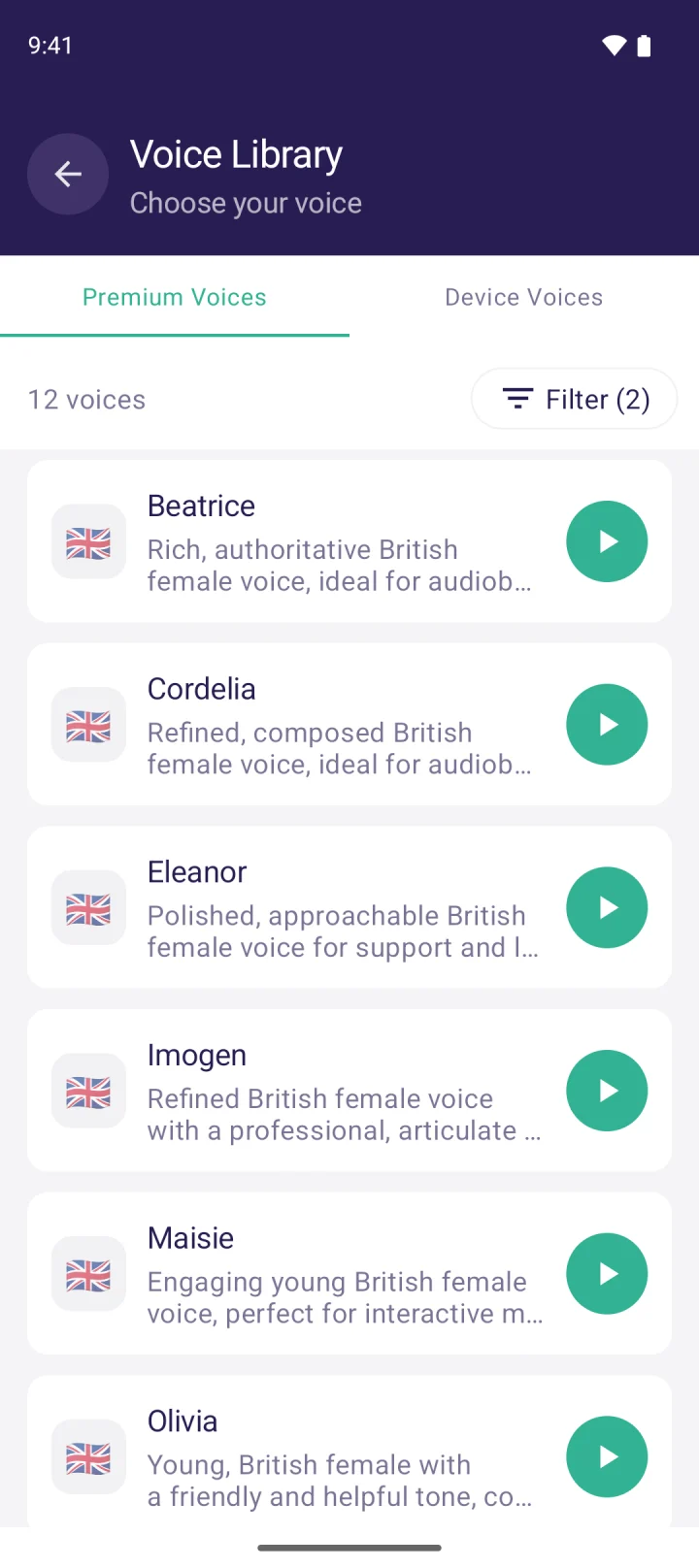
The best way to judge realistic text to speech is to listen. MyVoice has 278 natural AI voices across 15 languages and 24 regional accents, including US, UK, Australian, Indian, Irish and Nigerian English. In the app, you can filter by gender, age and accent and preview any voice before choosing it.
You don’t need to install anything to try them. Our homepage voice sampler lets you hear every voice’s sample, so you can find one that sounds right before you download. If you use text to speech to communicate, our page for AAC users explains how MyVoice fits into everyday conversation.
FAQ
What is the most realistic AI voice in 2026?
There’s no single winner. ElevenLabs has a strong reputation for realism, and major providers like Google, Microsoft and OpenAI offer natural neural voices. Blind listening comparisons such as TTS Arena are the fairest guide, but the best voice for you depends on your language, accent and use.
Can people tell AI voices from real ones?
In short clips, often not. Over longer listening, or with tricky names, numbers and emotional content, small tells usually appear.
What makes text to speech sound robotic?
Mainly flat prosody: little variation in pitch, even pacing, unnatural pauses and stress on the wrong words. Older systems also sounded choppy where recorded fragments were joined together.
Is a realistic AI voice generator free?
Many offer free allowances. MyVoice’s free tier includes 3,000 AI voice characters a month plus unlimited offline on-device voices. Our guide to free text to speech covers other options and their limits.
Realistic voices have come a long way, and the right one can make text to speech feel far more like your own voice. Have a listen to MyVoice’s voices and see which one sounds like you.
Download MyVoice
Try for free
Natural AI voices, saved phrases, and full accessibility support on iOS and Android.